
The Timeless 21: The courses that have been ranked on every list of America's 100 Greatest Courses
Back in 1855, the Bordeaux wine region of France created a ranking system of its chateaus. Regional merchants and wine cognoscenti developed a novel classification of 58 chateaus based primarily on reputation and trading prices. The estates were separated into five tiers, or "growths," with four wines—Chateau Lafite Rothschild, Chateau Latour, Chateau Margaux and Chateau Haut-Brion—designated as the most prestigious First Growths and the rest arranged from Second to Fifth Growths.
Though there have been periodic alterations to the classification system, the hierarchy has remained relatively constant. The system isn't perfect—wine quality fluctuates vintage to vintage, ownerships change, and only "Left Bank" wines (blends composed most heavily of Cabernet Sauvignon) were included, leaving out entire Bordeaux regions like St. Emilion and Pauillac that produce equally exquisite, Merlot-based bottles. But even today the classification tiers convey a unified standard of quality and history, with the coveted First Growths regularly commanding the largest prices and audience of collectors (a fifth, Chateau Mouton Rothschild, was elevated to First Growth status in 1973).
More from Golf Digest

A similar kind of sorting plays out in our biennial ranking of America’s 100 Greatest courses. Golf Digest's first ranking, America's 200 Toughest Courses, came out in 1966 and evolved over the subsequent years into a vastly more detailed and category-based set of scores that quantify architecture beyond mere difficulty. In that time, amid the hundreds of courses that have ascended and fallen, only 21 have appeared in all 31 editions of Golf Digest's top-100 rankings.
Taken together, these 21 courses represent the most enduring examples of U.S. architectural excellence as expressed by our 100 Greatest lists, the First through Fifth Growths of American golf.
Do these courses stand clearly above all others in the country? Not necessarily. Just as the classification of 1855 could not anticipate future Bordeaux chateaus and did not grant access to Right Bank wines, there are golf courses omitted because their pedigrees were only recognized at a later date: National Golf Links of America, currently ranked seventh, was not an established presence in our rankings until 1985; and Crystal Downs, No. 15, was off the grid until 1989. Similarly, dozens of outstanding courses built since 1966 have claimed spots high in the ranking, and other landmark designs have had otherwise continuous runs broken by just one or two off cycles.
That said, the timelessness and consistency of these 21 courses makes them stand apart as exceptional. Here is our own classification of golf’s finest architecture based on each club’s historic placement in the America’s 100 Greatest Courses ranking.
FIRST GROWTHS
AUGUSTA NATIONAL GOLF CLUB
Augusta has only fallen out of the top 10 in our rankings once, in 1981, for no explicable reason other than internal debate amongst our ranking committee. [Note: Prior to 1985, the courses were organized into groups of 10, organized (and occasionally brokered) in closed door meetings by a group of national selectors that included luminaries like Sam Snead, Tom Watson, Joe Dey, Frank Hannigan and others]. Since 1985, and despite all the alterations it’s received, Augusta National has never been outside the top three, claiming the top spot on three occasions, most recently in 2015-2016.

Dom Furore

BEN WALTON

Dom Furore

Dom Furore

Dom Furore

Stephen Szurlej

Dom Furore

Dom Furore

JD Cuban

J.D. Cuban

J.D. Cuban

JD Cuban

Stephen Denton
CYPRESS POINT CLUB
The wider golf world got its first up-close view of this Alister MacKenzie masterpiece in 35 years during the 2025 Walker Cup. Its charms and brilliant orchestration of sand, bunkers, cypress trees, dazzling greens and ocean make it easy to understand why it's never been lower than fourth in the ranking, though it's also never been first, likely due to a perceived shortage of length. The late Sandy Tatum described the famous 16th hole as the "Sistine Chapel of golf," but the whole course falls within that metaphor.

Carlos Amoedo

J.D. Cuban

Carlos Amoedo


J.D. Cuban

Carlos Amoedo
](http://golfdigest.sports.sndimg.com/content/dam/images/golfdigest/fullset/2015/07/21/55ad8e80add713143b42e6c9_courses-2013-02-cosl03_cypress_point_618.jpg.rend.hgtvcom.1850.1321.suffix/1573448858917.jpeg)
Stephen Szurlej
From Golf Digest Architecture Editor emeritus Ron Whitten:
Cypress Point, the sublime Monterey Peninsula work of sandbox sculpture, whittled Cypress and chiseled coastline, has become Exhibit A in the argument that classic architecture has been rendered ineffectual by modern technology.
I'm not buying that argument. Those who think teeny old Cypress Point is defenseless miss the point of Alister MacKenzie’s marvelous design.
MacKenzie relished the idea that Cypress Point would offer all sorts of ways to play every hole. That philosophy still thrives, particularly in the past decade, after the faithful restoration of MacKenzie’s original bunkers by veteran course superintendent Jeff Markow.
Explore our complete review here—including bonus photography and ratings from our expert panelists.
MERION GOLF CLUB (East)
Merion, opened in 1912, is one of the finest expressions of classical American architecture, a course beloved for how it manages to be both quaintly quirky (it's somehow shoehorned into one of the smallest parcels of land of any great course) and immensely formidable (as host of five U.S. Opens, with another one coming in 2030). It's been a fixture inside the top 10 since 1971, peaking at No. 5 twice.

Matt Hahn

Courtesy of the club

Courtesy of the club

Matt Hahn

Matt Hahn

Matt Hahn

Matt Hahn


Stephen Szurlej


Stephen Szurlej

OAKMONT COUNTRY CLUB
Like Merion, Oakmont (1904) is one of the two or three most architecturally significant courses of the early 20th century (1900 to 1915) and remains the game's most confounding designs for every level of golfer, amateurs to professionals. It does it in its own way with big sloping fairways, frightening rough and mirror-like greens that were as diabolical during the 2025 U.S. Open as they were during the first Open in 1927 when the winning score was 301. Currently ranked fifth, Oakmont is golf royalty and has never been outside the top 10.

Jeff Marsh

Jeff Marsh

Jeff Marsh

Jeff Marsh

Jeff Marsh

Jeff Marsh

Jeff Marsh

Jeff Marsh

Jeff Marsh

Jeff Marsh

Jeff Marsh

Jeff Marsh

Jeff Marsh
PINE VALLEY GOLF CLUB
Royalty is one thing, but if you're looking for the actual king of American golf courses, we present Pine Valley, a design that's held the No. 1 spot in our rankings more than any other course by a factor of seven. Set in the wild pine barrens of southern New Jersey, it is a monumental achievement in architecture with 18 holes that are original, distinct, complex and breathtaking, the totality of it created by a consortium of the era's greatest design minds working with founder George Crump (and continuing after his death).

Carlos Amoedo

Dom Furore

Dom Furore

Courtesy of the club/Charley Raudenbush

Photo by Dom Furore

Dom Furore

Golf Digest/Photo by Dom Furore

Photo by Dom Furore
More from Golf Digest

SECOND GROWTHS
PEBBLE BEACH GOLF LINKS
A strong case can be made that Pebble Beach belongs with the First Growths: It’s a cornerstone American course in one of golf’s best settings that’s second to none in tournament pedigree. It has thrived inside the top 10 and even assumed the No. 1 position once, in 2001, making it one of only three courses since 1985 to hold the top spot. But the scores slipped incrementally since that year and Pebble briefly fell to No. 12 in 2023-2024, a hiccup than none of the others in the top tier have suffered (it climbed back to No. 9 in 2025-2026).

Stephen Szurlej

Sherman Chu


Evan Schiller


Getty Images


Photo by Joann Dost

Keyur Khamar

Stephen Szurlej
SEMINOLE GOLF CLUB
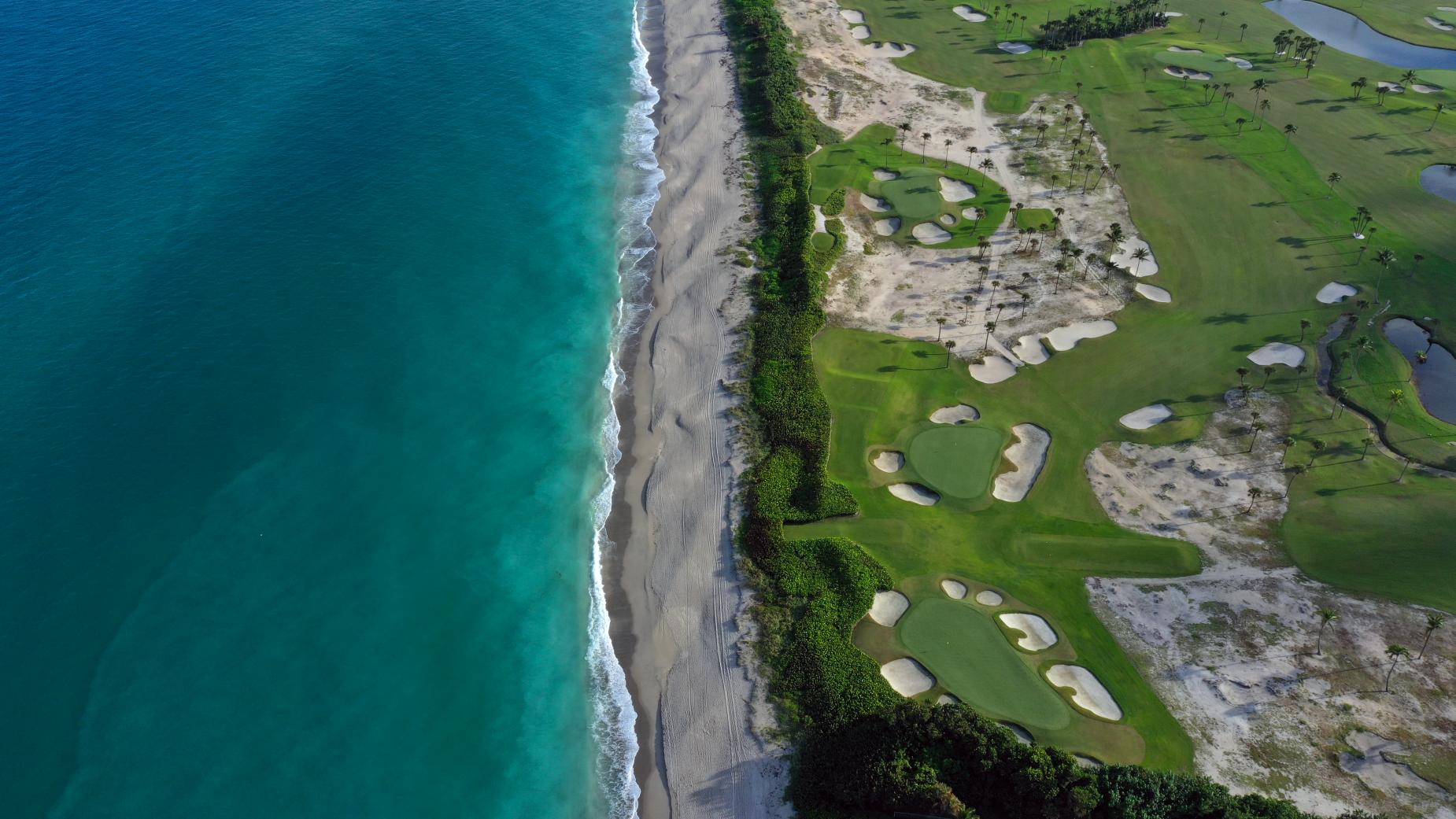
Seminole has cracked the top 10 five times since 1985 but has spent most of the last six decades on the outside looking in, though never further away than 19th place (in 1993-1994). This is a testament to its fundamentals, particularly its location along the Atlantic dune ridges of Juno Beach, Fla., and a routing that architects consider among Donald Ross’ best. But like Augusta National, the club has continuously evolved the course’s bunkers, aesthetics and other design features under the guidance of architects like Dick Wilson, Brian Silva and Bill Coore and Ben Crenshaw. Now Gil Hanse and Jim Wagner are orchestrating what may be the biggest architectural remodel to date. We’ll see how it impacts Seminole’s already lofty status.
Carlos Amoedo

Carlos Amoedo

Carlos Amoedo

The par-3 17th at Seminole Golf Club.
Carlos Amoedo
Carlos Amoedo
.jpeg.rend.hgtvcom.1850.1233.suffix/1573227586228.jpeg)
Jon Cavalier

Stephen Szurlej
WINGED FOOT GOLF CLUB (WEST)
Like Seminole, Winged Foot has danced in and out of the top 10 since the beginning, one foot in and one foot out. It peaked at No. 5 from 1985-1988 but has fluctuated between 11 and 13 the last four cycles. Winged Foot West proves how difficult it is to maintain top 10 status since one could reasonably argue the course has never been better—visually, functionally, intellectually—following a significant Hanse and Wagner renovation in 2017 that thinned trees, rebuilt the bunkers and enlarged and polished A.W. Tillinghast’s remarkable set of greens, masterpieces of slope and movement. As is sometimes said, there are at least 20 top 10 courses in the U.S., and Winged Foot West is one of them.

Dom Furore

Dom Furore

The 18th green at Winged Foot (West).
Dom Furore

No. 17
Dom Furore

LC Lambrecht

The ninth hole with the iconic Clifford Wendehack clubhouse in the background.
Dom Furore
THIRD GROWTHS
LOS ANGELES COUNTRY CLUB (NORTH)
Talk to people who know golf in Los Angeles, and you’ll get a roughly 50/50 split as to which course they like better, LACC North or Riviera. Our rankings have been just as divided as the two Hollywood stars have essentially circled each other for 60 years, each taking a star turn only to be upstaged later by the other. LACC has the slightly higher achievement, reaching No. 15 in 1989-1990, and has taken a little more of the spotlight of late following a stunning 2010 resurrection of the George Thomas architecture by Hanse and Wagner. It’s held the 16th spot in the ranking the past two cycles.

Carlos Amoedo


Courtesy of Los Angeles CC

Courtesy of Los Angeles CC


Courtesy of Los Angeles CC

Copyright USGA/John Mummert
OAKLAND HILLS COUNTRY CLUB (SOUTH)
When our panel began considering Oakland Hills’ South Course, they were reviewing a hybrid Donald Ross/Robert Trent Jones (who made major modifications for the 1951 Open) design that was later reworked by Arthur Hills and Rees Jones. They liked it and never scored it worse than 24th in the country, occasionally placing in the top 10. After a major 2021 Gil Hanse and Jim Wagner remodel flipped the architecture almost entirely back to Ross’ design, panelists continued to love it, though the love manifested in a move of just one place forward to its current position of No. 20 even while the experience of playing it is very different. Rankings can be a funny thing, but there’s nothing funny about one of the game’s greatest sets of greens or how lasting an impression the South course makes, no matter the iteration.

L.C. Lambrecht/Oakland Hills

L.C. Lambrecht/Oakland Hills

L.C. Lambrecht/Oakland Hills

L.C. Lambrecht/Oakland Hills

L.C. Lambrecht/Oakland Hills

L.C. Lambrecht/Oakland Hills

L.C. Lambrecht/Oakland Hills
L.C. Lambrecht/Oakland Hills
OLYMPIC CLUB (LAKE)
Olympic Club’s Lake course in San Francisco lived inside the top 10 for the first 23 years of the ranking before sliding down to No. 17 in the 1989-1990 edition. Since then, it’s relocated to the teens, then the 20s, and has settled in the mid-30s for the last decade. Some of the retreat could be attributed to some renovation work that was not always well received, but another prominent retouching by Hanse and Wagner in 2023 also did not produce any movement in the 2025-2026 ranking—it stood pat at No. 35, showing how difficult it can be to generate forward momentum when you’re already one of the three dozen best courses in the country. But the work was much needed and indeed improved the design as it cleared away too many overgrown cypress, addressed drainage and concerning bunker issues, expanded hole locations on the greens and created a new drivable par-4 seventh, instantly one of the most interesting holes on the course. And through it all, the Lake Course remains what it has always been: one of golf’s most challenging tournament courses for great players.

Evan Schiller

Kirk Rice

Frank Morse

Derek Duncan


Stephen Szurlej
RIVIERA COUNTRY CLUB
Los Angeles Country Club’s recent ascendence has not come at the expense of “Riv”—during the last two cycles the course has enjoyed its highest ranking, 18th, since 1985. That’s not to say the ship is always steady. Riviera has had some wild swings the last two decades after Tom Fazio’s substantial renovation in 2000, falling to 47th in 2005-2006 and to 61st the following cycle. But rankings are always a case of trajectory and where you are now, and the beloved George Thomas design has been clawing back ever since. It will host the U.S. Women's Open next year, the Olympics in 2028 and the U.S. Open in 2031 for the first time since 1948.

Bill Hornstein


Carlos Amoedo

Taku Miyamoto/Courtesy of Riviera Golf and Tennis, Inc.

Bill Hornstein

Carlos Amoedo

Carlos Amoedo

Taku Miyamoto/Courtesy of Riviera Golf and Tennis, Inc.
Carlos Amoedo

Taku Miyamoto/Courtesy of Riviera Golf and Tennis, Inc.

Bill Hornstein

Bill Hornstein
SOUTHERN HILLS COUNTRY CLUB
Tulsa’s Southern Hills has been the archetype of the sweltering Southern tournament brute since it hosted its first U.S. Open in 1958, won by Tommy Bolt. Though hardly the longest course and lacking one of the biggest USGA course ratings in 1966 (just 72—the highest at the time was 75), it’s exactly the kind of design our panelists of the era would idolize for its ever-tightening dogleg fairways (the trees were still growing) and menacing Perry Maxwell greens. It debuted in the top 10 and later settled, for the most part, in the 25 to 35 range. A 2017 Hanse and Wagner reclamation of the Maxwell character (mostly the green edges and bunkers, along with significant tree clearing) has pushed its ranking back inside the top 30.

Brian Oar

Gary Kellner/PGA of America/Getty Images

Brian Oar

Brian Oar

Andy Johnson/Courtesy of Southern Hills

Southern Hills marks a new era of more dynamic major-championship setups (the par-4 fourth).
Brian Oar

Players will have to decide how far to press their luck with drives on the par-4 third.
Brian Oar
More from Golf Digest

FOURTH GROWTHS
BALTUSROL GOLF CLUB (LOWER)
The parallels between Baltusrol and Third Growth Oakland Hills are significant. The primary tournament courses, the Lower and the South, respectively, came into their own as major championship venues after extensive mid-century Robert Trent Jones remodels, and each were at the height of their fame during the first decades of the Golf Digest rankings, fixtures in the top 20. Later, the architecture of each club was revamped by Jones’ son, Rees. While the status of Oakland Hills stayed relatively consistent, Baltusrol slowly lost ground and over the last decade has resided in the 40 to 45 range. Recently, both clubs have hit the reset button, hiring Hanse and Wagner to reestablish the essence of their original 1920s designs by Tillinghast and Ross. The results at Baltusrol are impressive, and the design recently gained five spots.

Evan Schiller/Courtesy of the club

Evan Schiller/Courtesy of the club

Evan Schiller/Courtesy of the club

Evan Schiller/Courtesy of the club

Evan Schiller/Courtesy of the club

Evan Schiller/Courtesy of the club

Evan Schiller/Courtesy of the club

Evan Schiller/Courtesy of the club

Evan Schiller/Courtesy of the club

Evan Schiller/Courtesy of the club


OAK HILL COUNTRY CLUB (EAST)
Oak Hill could be viewed in the same frame as Baltusrol and Oakland Hills, just substitute Tom Fazio for Rees Jones as the post-RTJ remodeler, and Andrew Green, who conducted a return to the East Course’s Ross architecture in 2019, for Hanse and Wagner. Statistically the East Course has walked almost step for step with Oakland Hills as a perennial fixture in the 15 to 20 range, though it’s had fewer spins inside the top 10, just one appearance to the South Course’s eight. Today, they are neighbors residing side by side at Nos. 21 and 20.

Evan Schiller

The approach to No. 13.
Evan Schiller

The fourth and fifth holes at the renovated East course at Oak Hill Country Club.
Evan Schiller

Carlos Amoedo

Carlos Amoedo

Carlos Amoedo

A closer look at the 13th hole.
Evan Schiller

The renovated East course will host the 2023 PGA Championship, the fourth PGA in the club's history.
Evan Schiller


Evan Schiller Photography

Evan Schiller Photography

Evan Schiller Photography

Evan Schiller Photography

Evan Schiller Photography

Evan Schiller Photography

Evan Schiller Photography

Evan Schiller Photography

Evan Schiller Photography
PEACHTREE GOLF CLUB
If there’s a sleeper in our classification it’s Atlanta’s Peachtree Golf Club, one of only two courses built after World War II. Like Cypress Point, Pine Valley and Seminole, it’s never hosted a major championship, but in contrast to those venerated clubs Peachtree has existed quietly despite being developed by Bobby Jones in the late 1940s. Its closest analogue is Augusta National, genetically (see Jones, the founder, and Robert Trent Jones, the architect), in aesthetics (massive rolling greens, fairways draped over hills through tall Georgia pines with dazzling springtime botany) and some of the country’s finest playing surfaces. It once fell from a high of 16th (1991-1992) to a low of 87th (2007-2008), but since then, as if discovered anew, the course has steadily maneuvered all the way back to No. 22.

Dave Sansom

Dave Sansom

Dave Sansom

Dave Sansom

Dave Sansom

Courtesy of Peachtree GC

Courtesy of Peachtree GC
PINEHURST RESORT (No. 2)
One might think a course as distinctive, influential and historically prominent as Pinehurst No. 2 might be a First or Second Growth. Through the first seven editions of the rankings it was, but the juggernaut also jumped between the first and fourth 10s. Most of this sling-shotting occurred while No. 2 was living an alternate life as a green, parkland-style course with mesmerizing greens but thick, carpeted Bermuda roughs. After Bill Coore and Ben Crenshaw restored the original sand and wiregrass borders to the holes in 2010, reviving the unique, indigenous Pinehurst character, a surge in the poll was expected. Stubbornly, the course remains confined to a purgatory hovering around No. 30. To this architecture editor, No. 2’s persistent position outside the top 20 is the most confounding aspect of our rankings.

Stephen Szurlej


Dom Furore

Stephen Szurlej

Dom Furore

The 13th hole at Pinehurst No. 2.
Courtesy of the resort

Dom Furore

Dom Furore
FIFTH GROWTHS
CONGRESSIONAL COUNTRY CLUB (BLUE)
The first holes at Congressional Country Club, outside Washington D.C., were built in the 1920s by architect Devereux Emmet, but the Blue Course as we know it didn’t come into being until 1957 when Robert Trent Jones combined them with nine new holes. The Blue was fresh on the minds of the new Golf Digest regional selectors after Ken Venturi won the 1964 Open there, and they inaugurated it inside the top 40. Since 1985, Congressional has been as high as No. 50 but fell as low as No. 91 in 2021-2022. That decline, along with turf and maintenance challenges (and a 16 under finish by Rory McIlroy in the 2011 U.S. Open), spurred the powers that be to consider drastic measures. The course as we know it now is the creation of Andrew Green, who revamped every hole in the spirit of Emmet rather than Jones, clear-cutting the site of its forest of trees and leaving nothing as was. The work worked, and Congressional has elevated 14 places, to No. 67.

James Lewis

James Lewis

James Lewis

James Lewis

James Lewis

James Lewis

James Lewis
INVERNESS CLUB
Inverness is another course that’s gone through several iterations—at least eight different architects have worked on the course in some fashion. Two U.S. Opens were played on the original Donald Ross version (he remodeled it in 1918), another on the course renovated by Dick Wilson in 1957, and a fourth on the Tom and George Fazio 1977 remodel that introduced several new holes built on adjacent pastureland. Inverness rose and fell through the years, reaching No. 17 in 2003-2004 then sagging to No. 89 in 2017-2018, before Andrew Green’s 2018 redesign steadied the ship. The remodel, including Green’s own new holes that replaced the Fazio holes, helped the club get back to its current place at No. 62 after reaching No. 58 in 2023-2024.

Fred Vuich/USGA

Fred Vuich/USGA

Patrick Smith
MEDINAH COUNTRY CLUB (No. 3)
The narrative for Fifth Growths is clear: historic courses with major championship pedigree watch their star fall down the 100 Greatest ranking, then opt for a radical re-do by basically pulling up stakes on the old design and starting over. Medinah, long considered one of the country’s sternest driving and approach-shot tests, host of three U.S. Opens, two PGAs and a Ryder Cup, lived in the top 20 until 2010 when it began a freefall to No. 93 two years ago. Like going to the bullpen to stop an offensive onslaught, the club signaled to the Australian firm of Geoff Ogilvy, Mike Cocking and Ashley Mead to reimaging the classic Chicagoland tree-lined design. They conjured a more open concept that recalled No. 3’s early years that meanders through meadows, dips into less dense woods and crosses the property’s famous lake in more inventive, strategic ways. Early results suggest the changeup worked—after teetering on the brink, Medinah jumped 19 places back to the safety of No. 74.

Medinah Country Club/Seth Jenkins

Matt Rouches/Fried Egg Golf

Matt Rouches/Fried Egg Golf

Matt Rouches/Fried Egg Golf

Matt Rouches/Fried Egg Golf
SCIOTO COUNTRY CLUB
You can copy/paste the scenario of the previous three Fifth Growths onto Scioto. Theirs is the story of a former U.S. Open, PGA Championship and Ryder Cup host that underwent a major mid-century modernization, struggled with its identity as the years went on, and finally decided to turn back the clock. In this scenario, Scioto most closely resembles Inverness, with Andrew Green bringing back the Donald Ross architecture that had been papered over. Interestingly, the Scioto reviews that have locked it into the 100 Greatest list since 1966 were based on the 1957 Dick Wilson revision, even if its ranking slumped to positions in the 50s and 60s. We’re curious why Scioto hasn’t received the same jolt that others have after Green’s excellent Ross-inspired work—at last publication it sits at No. 82, its lowest placement in the rankings, ever.

Evan Schiller

Evan Schiller

Evan Schiller


Evan Schiller

Evan Schiller

Evan Schiller

Evan Schiller

Evan Schiller

Evan Schiller

Evan Schiller

Evan Schiller

Evan Schiller
More from Golf Digest

Explore Golf Digest's new Course Reviews section where you can submit a star rating and evaluation on all the courses you’ve played. We've collected tens of thousands of reviews from our course-ranking panelists to deliver a premium experience, which includes course rankings, experts' opinions, bonus course photography, videos and much more. Check it out here!