JOIN NOW
Advertisement
Golf Digest's Best Young Teachers in America
We searched from one end of the country to the other to identify the best of the best
Today's Feed
FEED REFRESHED
Time was when we thought a young college player getting a PGA Tour invite was cute—now it’s just another sign of prudent investment in elite talent.

Kihei Akina, a sophomore at BYU and NCAA Freshman of the Year is playing in this week’s Bank of Utah Championship on a sponsor’s invite. He's the latest young player to snap up an NIL deal, with Ping announcing it signed the 20-year-old Hawaii native to play 14 Ping clubs, carry a Ping bag and wear a Ping hat in all non-collegiate events. Akina, who reportedly was offered scholarships from 50 college programs after a junior career that included earning individual medalist honors three times in the Utah state high school championships, became the youngest Utah Open winner since 1934 when he won the title as a 19-year-old in 2025. He was a member of the U.S. Walker Cup team this year,. a quarterfinalist at the British Amateur, and a a Fred Haskins Award finalist.Akina finished T-16 at the Puerto Rico Open in March on the PGA Tour and set the Big 12 conference tournament scoring record with a 63 at Prairie Dunes earlier this spring.

/content/dam/images/golfdigest/fullset/akina-ping.jpeg
ADVERTISEMENT
This dude's driver head could not have broken off in a worse spot.

First of all, be careful how close you set up near tee markers. One golfer made a critical error in judgement with that, but the mistake was compounded by the fact that his driver head flew off a cliff at Sand Hollow Resort. Have a look:

Tough spot. Literally. Sorry, man, but that club is a goner. 

Tom Kim’s pursuit for a military exemption is off to a good start.

Kim starred in the Presidents Cup over the weekend in Chicago, but ended up leaving early after winning his Sunday singles match to fly to Japan to compete in the Asian Games, and for good reason: If the 24-year-old Kim wins either the gold medal or a team medal, he would be excused from mandatory military service in his native South Korea. All able-bodied men are expected to serve between 18 and 21 months and must begin their service by the age of 28. Kim turned in an opening 67 at Kasugai Country Club East Course, two back of the lead. Sunjae Im and Si Woo Kim were able to secure a team gold in 2022, earning exemptions to continue their professional careers.

Matt Fitzpatrick does not find those random texts as funny as everyone else does.

It's hard to believe anything you see on the internet these days. My antennas were certainly up over Twitter user Tom Egbers claiming he's been texting Matt Fitzpatrick after he wins a golf tournament, despite Fitzpatrick having no idea who he is. Apparently, the texts are very real, though. Fitzpatrick, who just won the French Open on the DP World Tour, was asked about it at the Alfred Dunhill Links Championship, and he doesn't seem to find the whole thing as funny as everyone else does: 

We'd say lighten up, Fitzy, but we've all gotten texts from random numbers we don't have and had no idea how to handle it. Do you say you don't have their number saved and risk offending someone you've met prior? Do you ignore entirely? Do you just pretend to know them? Fitzy actually handled that business quite well in the texts above. The question on everyone's mind, still, is how did this guy get Fitzy's number?

ADVERTISEMENT
Francis Ouimet remains the gold standard for hometown heroes claiming golf glory on their home course.

The Brookline, Mass., native winning the 1913 U.S. Open at The Country Club, a golf course in which he lived across the street is going to be hard to top. But in two different USGA championships this week, there are storylines that echo Ouimet’s feat. At the U.S. Senior Women’s Amateur, Lara Tennant, a three-time past champion, reached the quarterfinals on Tuesday as she competes on her home course, Portland (Ore.) Country Club. To get to the final eight, Tennant, 59, had to defeat two other former winners in Ellen Port and Judith Kyrinis. There are also two other past champs still competing in Nadene Gole and Shelly Stouffer.

Meanwhile, at the U.S. Mid-Amateur Championship, Matt Hutchins knows the Lido Course at Sand Valley Resort in Wisconsin better than any of the remaining quarterfinalist in the event. That’s because the 29-year-old works at the resort as a caddie. The local support for Hutchins, a reinstate amateur who is playing in his first USGA championship, helped motivate him as he played double rounds on Tuesday while nursing a calf injury.

A longtime golf voice has weighed in on that testy Scottie Scheffler Presidents Cup interview.

If you thought we were done talking about Scottie talking to Golf Channel's Cara Banks, you were wrong. Peter Kostis is the latest to weigh in on the situation—and he is full Team Scottie on this one:

Interesting take from Kostis, but certainly one that needs to be considered given his expertise in this area. Anyway, we had plenty of our own thoughts on this as well on this week's episode of The Loop podcast. 

The conditions at Yale Golf Course are in the news again.

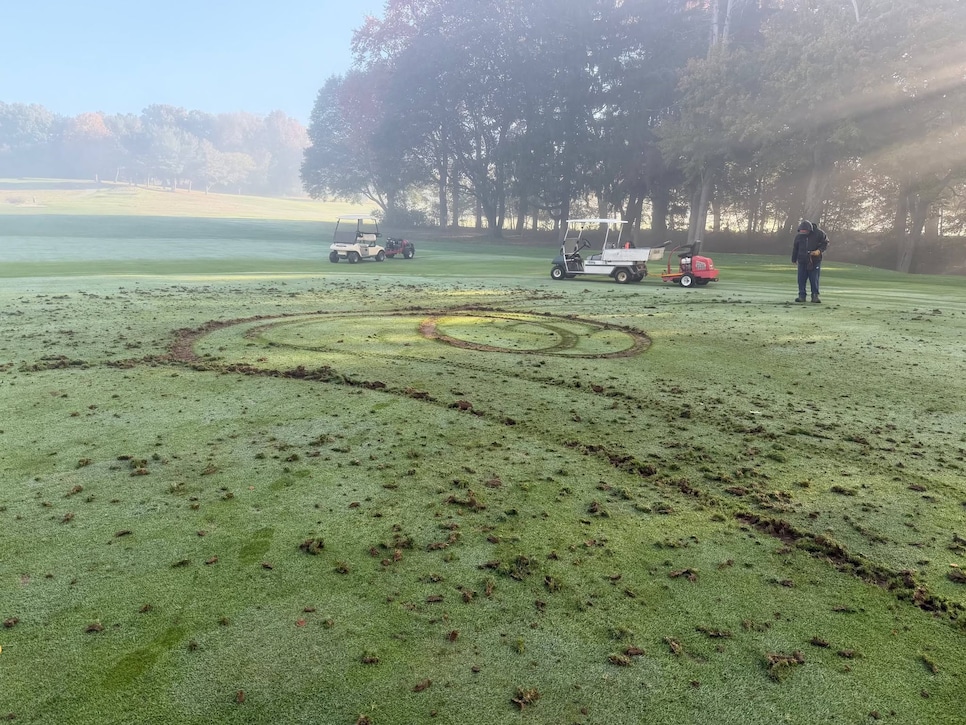
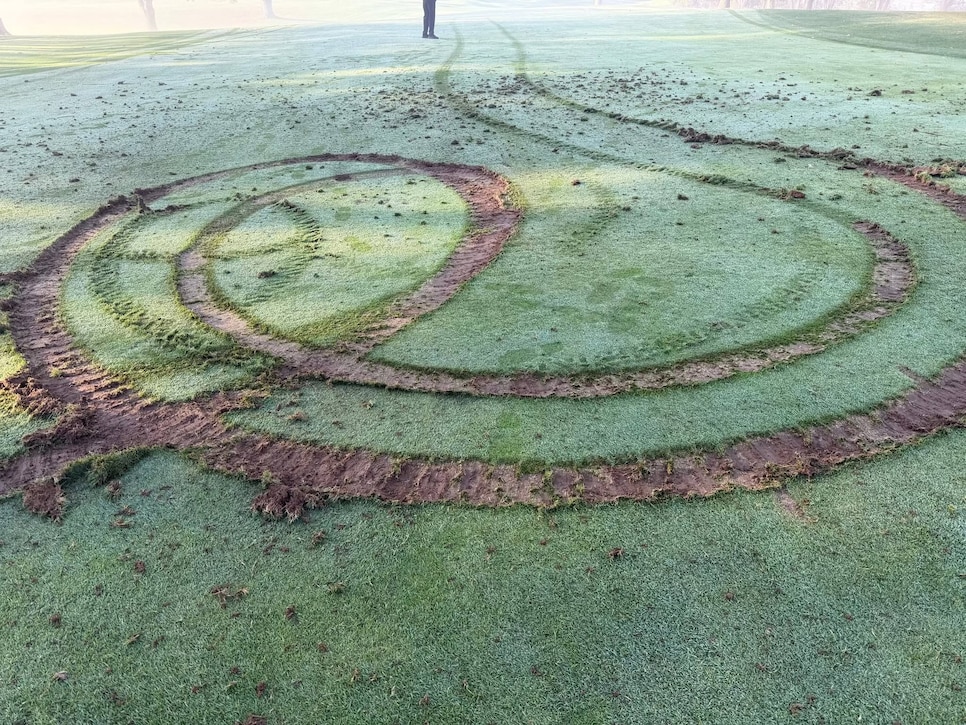
Back in August, our Alex Myers documented the shoddy conditions he saw during an August round at Yale Golf Course (photos from Myers below), which underwent a massive restoration by Gil Hanse and his team over the past couple of years. Now The Athletic's Gabby Herzig has dug deeper, finding out the university is acknowledging a problem and looking to rectify things for future seasons. Herzig's piece is a must-read for anybody fascinated by course design, but our biggest takeaways were Hanse's quote: “I do not believe that there is anyone who has been involved in this project who could be objectively happy with how the course is currently being maintained and presented.” Hanse and his team are liaising on getting the course back to semi-decent conditions. It's been a tough summer in the Northeast, but no other course looks like Yale right now, and the university is charging $350. Give Gabby's piece a read. It'll be interesting to see how Yale fares in our Best Renovation survey, which will publish in January, considering how highly anticipated Hanse's work was, and considering conditioning is only 1/8 of the formula we use for scoring courses.

ADVERTISEMENT
Matt Fitzpatrick has a pen pal;

the problem is that Fitzpatrick has no clue who it is. The Internet does, however, and the man behind the texts is apparently golf obsessive Tom Egbers. For what appears to be the last few years, Egbers has been congratulating Fitzy on all of his victories while also never revealing his true self:

The trusting Brit will send a thanks each time, but still can't tell who the messages are coming from. It’s a beautiful friendship, especially when you remember that Egbers even helped out Alex Fitzpatrick in a tight spot.

One of the unnamed players behind Callaway's Quantum Mini Spinner just won on the LPGA.

When Callaway announced the Quantum Mini Spinner, the company said the club was inspired by several JLPGA players who wanted more stopping power from their high-lofted fairway woods. What Callaway didn't share was their names.

Consider the introduction made for one of the pros.

Yuna Nishimura, a six-time winner in Japan, picked up her first LPGA title last week at the Walmart NW Arkansas Championship, closing with a 66 at Pinnacle Country Club to win by five. The Quantum Mini Spinner 7-wood she helped develop was in the bag.

Nishimura's problem will sound familiar to anyone carrying multiple lofted woods. Her 7-, 9- and 11-woods weren't generating enough spin or a steep enough landing angle on approaches into par 4s and par 3s, so she asked Callaway for a club that launched high and stopped quicker. Since the Mini Spinner went in play, Callaway said her spin is up 600 to 700 rpm, and her peak height has climbed too.

Callaway calls it "the scoring wood," and the recipe runs counter to most modern fairway woods. Rather than a low center of gravity (the head's balance point) built to knock spin down, the Mini Spinner pairs a high CG with an Ai-optimized face designed to add spin. It also plays 0.75 inches shorter than a standard fairway wood for more consistent contact, with a taller face that offers more usable hitting area out of the rough.

Callaway said the Mini Spinner is already the No. 1-selling fairway wood in Japan. Now the club can add an LPGA win to its resume.

/content/dam/images/golfdigest/fullset/2022/Yuna Spinner 1.png
Untucked at the U.S. Mid-Am?

Folks, is the game gone? People are asking themselves that very question in the replies of this tweet send out by the USGA on Monday. In the video, you'll see highlights of Drew Kittleson taking down Stephen Behr Jr. in the Round of 64, 2 and 1. The issue people have? Kittleson played the whole match ... UNTUCKED. The horror:

However you feel about dress codes, it's undeniable that this is a startling sight. We're talking about a USGA event, here, and this man is in the match play portion of it fully untucked and proud of it. They've even got him front and center on the main U.S. Mid-Am web page. Crazy times we're living in. 

ADVERTISEMENT
Bryson's lefty swing is absolutely filthy.

Bryson DeChambeau is a shape shifter. He's assumed various roles throughout his career—the scientist, the body builder, the YouTube host—carving out countless unforgettable moments, both good and bad, along the way. Now, we may be witsnessing of the birth south-paw Bryson after this video of him PIPING a drive lefty went viral on Tuesday.

Sheeeesh. That's one of the best switch-hitter swings we've seen since Mickey Mantle. Sure, his clubhead and ball speeds are noticeably slower, but as a result, his tempo actually seems smoother and sweeter. Almost Ernie Els-ish in its effortless arc. Keep hating all you want, but this is another point on the board for DeChambeau, who despite all his eccentricities, continues to prove he's one of the most multi-talented humans in all of golf.

The subject of Luke Kerr-Dineen’s most recent Game Plan video has also been a personal obsession for the last decade.

In identifying the keys to breaking 80, Luke notes one of the biggest is keeping your drives in play and away from trouble. Easier said than done? Maybe, especially on those holes when we have a mental block and repeat the same mistake. According to Golf Digest 50 Best Teacher Will Robins, one strategy for overcoming your nightmare hole is what he calls “scratching the record.” In other words, you seek opportunities to disrupt your pattern there by purposely hitting a bad shot – maybe even aim out of bounds off the tee. Why would you do that? Because the next time you play, you’ve ingrained a new pattern. “What actually happens is during that moment, you trigger such a response that you can't play the record again,” Robins said. “You can't go back and go, ‘Poor me. This happened to me,’ because your brain is completely freaked out, right?”