Best golf courses near Philadelphia, PA
Below, you’ll find a list of courses near Philadelphia, PA. There are 71 courses within a 15-mile radius of Philadelphia, 27 of which are public courses and 44 are private courses. There are 54 18-hole courses and 16 nine-hole layouts.
The above has been curated through Golf Digest’s Places to Play course database, where we have collected star ratings and reviews from our 1,900 course-ranking panelists. Join our community by signing up for Golf Digest+ and rate the courses you’ve visited recently.

The Union League Golf Club At Torresdale is one of the best golf courses in Pennsylvania. Discover our experts' reviews and course information.
View Course

Merion East has long been considered the best course on the tightest acreage in America, and when it hosted the U.S. Open in 2013, its first since 1981, the present generation of big hitters couldn’t conquer this clever little course. They couldn’t consistently hit its twisting fairways, which are edged by creeks, hodge-podge rough and OB stakes. Additionally, players couldn’t consistently hold its canted greens, edged by bunkers that stare back. Justin Rose won with a 72-hole total of one-over-par, two ahead of Jason Day and Phil Mickelson. With Gil Hanse's extensive two-year renovation after that tournament, making even more improvements at Merion's East Course, the design should be even more polished and pristine when the U.S. Amateur returns in 2026 and the U.S. Open returns again in 2030.
View Course
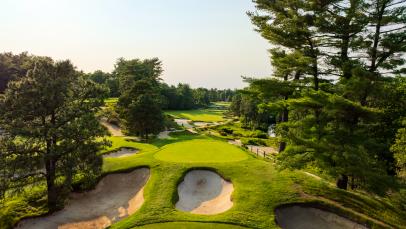
A genuine original, its unique character is forged from the sandy pine barrens of southwest Jersey. Founder George Crump had help from now-legendary architects H.S. Colt, A.W. Tillinghast, George C. Thomas Jr. and Walter Travis. Hugh Wilson (of Merion fame) and his brother Alan finished the job, while William Flynn and Perry Maxwell made revisions. Throughout the course, Pine Valley blends all three schools of golf design—penal, heroic and strategic—often times on a single hole. Recent tree removal at selected spots has revealed some gorgeous views of the sandy landscape upon which the course is routed, and Tom Fazio has put his own touch on the design with bunker remodels that have given the barrens a more intricate and ornate look.
View Course

Philadelphia Cricket was A.W. Tillinghast’s home club in his early years as a golfer, so when he laid out a new course for the club in the early 1920s, he devoted special attention to it. Over the century, it aged. Greens shrank, bunkers eroded, trees grew (including one right through the roof of a clubhouse veranda). In 2008, Keith Foster was retained to restore the course to its Tillinghast glory, but a poor economy postponed the work until the summer of 2013. The Cricket is now faithful to Tilly once again, with trees removed and original greens and bunkers reclaimed, including the famed “Great Hazard” that must be carried on the par-5 seventh. As per his request, Tillinghast’s ashes were scattered in the Wissahickon Creek that crosses the 18th green. The PGA Tour's Truist Championship was moved to Philly Cricket Club for 2025, with Quail Hollow Club hosting the PGA Championship.
View Course
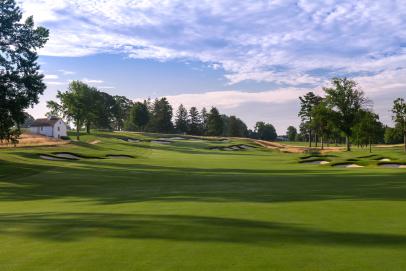
Aronimink is an object lesson in architectural evolution. After Donald Ross completed his design in 1928, he proclaimed, “I intended to make this my masterpiece.” That didn’t keep club members from bringing in William Gordon in the 1950s to eliminate out-of-play fairway bunkers and move other bunkers closer to greens. The course was later revamped by Dick Wilson, George Fazio and Robert Trent Jones. In the 1990s and into the 2000s, Ron Prichard, one of the profession’s original restoration specialists, began returning Aronimink back to Ross’ conception based on the architect’s drawings and field diagrams. But there was always a discrepancy between what Ross drew in plans and what was actually built in 1928. A more recent renovation by Gil Hanse and Jim Wagner, who live nearby, has put the course’s architecture more in line with what aerial photographs depict of the early design, particularly the bunkering that might have been imagined as larger in scale but built in smaller, more scatter-shot formations.
View Course

The original 18 at Philadelphia Country Club, known as Spring Mill, was designed by William Flynn in 1927 (Tom Fazio later added an additional nine holes in 1990, called Centennial). The appropriate word to describe the course and the property is “grand,” especially after Jim Nagle’s 2023 and 2024 renovation work expanded fairways and greens, upscaled the bunkering to better match Flynn’s original hazards and opened up the remaining sight lines so the full scale of the land’s movements and vistas across the west Philadelphia horizon could be appreciated. The design is full of standout holes like the uphill, double-dogleg second, the sweeping downhill fourth and the par-3 seventh nestled in a cove. But the second nine stretch of holes, particularly from the par-5 12th walking along a high ridgeline through the powerful dogleg right 17th that banks through a valley corridor into a green sitting in a secluded hollow are in a class with the best of any course in the Philadelphia market. Philadelphia Country Club was the site of the 1939 U.S. Open, won by Byron Nelson only after an additional 36-hole playoff with Craig Wood and Denny Shute. The tournament may be most remembered, however, as Sam Snead’s best chance to win the Open. Playing the 72nd hole, he needed only par to win but thought he needed a birdie to tie Nelson. After driving the ball in a bunker on the par-5 18th, he elected to go for the green with his 2½ wood instead of laying up with an iron. That shot caught another bunker under the lip and he proceeded to make an 8. The infamous hole is now the par-5 third—the sequencing changed when the clubhouse was relocated to the other side of the course in the 1970s.
View Course

Llanerch Country Club in Havertown is ranked as one of the best golf courses in Pennsylvania. Discover our experts' reviews and tee time information
View Course

Manufacturers' Golf & Country Club in Fort Washington is ranked as one of the best golf courses in Pennsylvania. Discover our experts' reviews and tee time information
View Course

Rolling Green is one of the best courses in Philly and lives up to its name with a very hilly par 71 routing. The defining feature of the course is the fact that nearly every one of these greens is perched and elevated, with steep bunkers on either side and severe false fronts short. While quite open and forgiving off the tee, it's no exaggeration to say that Rolling Green might be one of the most difficult approach-shot courses in America due to this. The difficulty is also supplied by the greens themselves, which are quite fast and slope mainly hard-to-back to front with the land. Expect excellent firm, fast conditioning and aesthetics similar to Lancaster Country Club. Contains one of the most challenging holes that Flynn designed—the uphill, 260-yard par-3 10th hole.
View Course

Founded in 1897, Huntingdon Valley started out as a nine-hole course before expanding to 18 in the 1910s. The club then had to move to its present site in the 1920s and acquired enough land for 27 holes. The main 18 was designed by William Flynn and Howard Toomey and opened for play in 1928. The third nine, called the C course, fell into disrepair during the Great Depression and only the main 18 was maintained. However, to coincide with the club’s centennial, they hired Ron Prichard to bring back what is now called the Centennial nine. The greens are difficult in terms of both undulation and slope. Huntingdon's routing is its strength, as it makes great use of incredibly rolling topography, where the only flat lie one gets is on the tee box. It also takes advantage of the valley and creek that the property sits on, meaning golfers have to navigate and avoid the tough features they bring.
View Course
Gulph Mills Golf Club in King of Prussia is ranked as one of the best golf courses in Pennsylvania. Discover our experts' reviews and tee time information
View Course

Philadelphia Cricket Club's Militia Hill course in Flourton is ranked as one of the best golf courses in Pennsylvania. Discover our experts' reviews and tee time information
View Course
When it originally opened in 1916, Cobbs Creek was among the few clubs in the United States to welcome all ethnicities. The historically inclusive course on the west side of Philadelphia hosted the 1928 U.S. Amateur Public Links. In recent years, the public course has fallen on tough times and closed in 2020. But in the spring of 2022, the course was scheduled to begin a long-awaited $65 million revitalization plan, which was to include a restoration of the Olde course, led by Gil Hanse and Jim Wagner. However, with a battle ensuing between those behind the project and locals, the future of Cobbs Creek is in limbo.
View Course
Find more courses near Philadelphia, PA