Courses
Best golf courses near Bloomington, MN
Below, you’ll find a list of courses near Bloomington, MN. There are 72 courses within a 15-mile radius of Bloomington, 49 of which are public courses and 23 are private courses. There are 47 18-hole courses and 25 nine-hole layouts.
The above has been curated through Golf Digest’s Places to Play course database, where we have collected star ratings and reviews from our 1,900 course-ranking panelists. Join our community by signing up for Golf Digest+ and rate the courses you’ve visited recently.

Minnesota Valley Country Club in Bloomington is one of the best courses in Minnesota. Discover our experts’ reviews and where Minnesota Valley Country Club sits in our rankings.
View Course
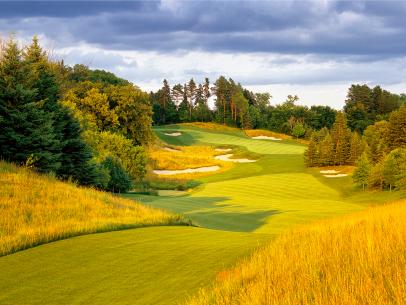
While Tom Fazio is best known for creating massive landscapes for his designs, Spring Hill required little manipulation of earth. Fazio utilized the existing rolling topography to form what is one of his most natural designs. Holes are isolated from one another by thick forests of evergreens and, in one section of the property, acres of maple trees that provide a brilliant color display each fall. With several tight fairways, marshland along some edges, many uphill approach shots into elevated greens and subtle movements in the putting surfaces, Spring Hill is also one of Fazio’s most challenging designs.
View Course
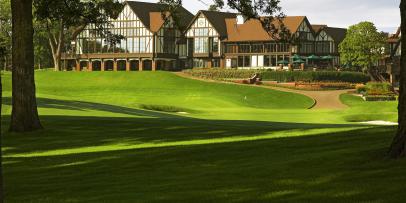
When Bobby Jones won the 1930 U.S. Open at Interlachen (completing the second leg of what would become the game’s first Grand Slam), fellow competitor Gene Sarazen insisted the course was tougher than everything but Oakmont. These days, the hilly, tree-lined design with small greens and plenty of bunkers has been the showcase of women’s professional golf, hosting the 2002 Solheim Cup, won by the American team, and the 2008 U.S. Women’s Open, won by Inbee Park. In 2023, Andrew Green will begin a major restoration of the Willie Watson design that Donald Ross revamped in 1922, possibly giving the course a similar ranking jolt that similar work at Inverness and Congressioinal delivered.
View Course

Midland Hills always suspected their course was designed by Seth Raynor in the early 1920s, but they had no records of what that course looked. They could intuit what some of Raynor's original holes were, but the overall architecture had dulled and shrunk over the years. That changed in 2018 when superintendent Mike Manthey discovered a 1921 irrigation map hidden above the ceiling in his office. The drawing showed Raynor's vision for the course including individual holes and bunkers, a roadmap that designer Jim Urbina used to recreate and sharpen the old templates like the Biarritz, Road and Eden. The improvements have help vault the course into the Best in State rankings for the first time.
View Course

Hazeltine might be the most controversial championship course of the modern era, designed by Robert Trent Jones for former USGA president Totten Heffelfinger, who used his considerable clout to bring the 1966 U.S. Women’s Open and 1970 U.S. Open to the then-very immature layout. Criticisms were so extreme that Trent Jones spent the next two decades remodeling it, straightening doglegs, relocating holes and rebuilding greens. In the past two decades his younger son, Rees Jones, assumed the reconstruction, with even greater success—and today the layout, like many in the old man's portfolio, is more Rees than Trent. Hazeltine hosted the 2009 PGA and 2016 Ryder Cup, the latter a bright spot for the American team, which perhaps is why the PGA of America has already awarded the 2028 Ryder Cup to this Minnesota site.
View Course

Minneapolis Golf Club is one of the best courses in Minnesota. Discover our experts’ reviews and where Minneapolis Golf Club sits in our rankings.
View Course
Somerset Country Club in Mendota Heights is one of the best courses in Minnesota. Discover our experts’ reviews and where Somerset Country Club sits in our rankings.
View Course
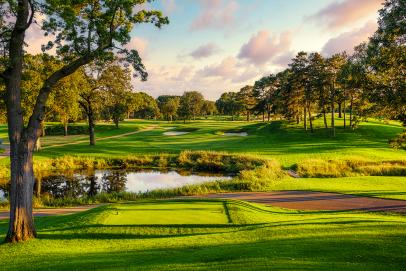
The Minikahda Club in Minneapolis is one of the best courses in Minnesota. Discover our experts’ reviews and where The Minikahda Club sits in our rankings.
View Course

Architect Ron Prichard took an existing layout by Charles Maddox and completed transformed it—with an brand-new course reopening in 2015 that is one of the best in Minnesota. Tyler Rae has done some renovation work in recent years to clear out a significant number of trees to open up sightlines and tweak green complexes to make some less severe. Still, Olympic Hills features intriguing greensites built in all shapes and sizes with a good variety of holes.
View Course

Town & Country Club in St. Paul is one of the best courses in Minnesota. Discover our experts’ reviews and where Town & Country Club sits in our rankings.
View Course

A muny packed with history, Keller hosted the 1932 and 1954 PGA Championships, a Western Open, and for nearly 40 years, from 1930 to 1968, hosted the PGA Tour's annual St. Paul Open. On top of all that, it also hosted the 1931 U.S. Amateur Public Links. As one of our Minnesota course-ranking panelists described: "Holes 11 through 16 are as good of a stretch of holes as anywhere in the state."
View Course

Braemar is a player-friendly public track just south of Minneapolis that offers wide, forgiving fairways. One of our panelists notes that the two nines play quite different, with the most compelling holes on the back side. In 1979, Braemar hosted the third edition of the since-discontinued U.S. Women’s Amateur Public Links.
View Course
For most of its history, Golden Valley has been in a state of flux. The club’s first course was designed by Tom Bendelow. Golden Valley later hired A.W. Tillinghast in the 1920s to construct a new course. A number of his bunkers were removed in the 1930s to reduce maintenance costs (Tillinghast, by this time, was traveling the country on behalf of the PGA of America advising clubs on ways to cut costs during tight economic times), and others were tinkered with and modified in one way or another. A series of mid-century renovations took the design further from the one Tillinghast put in the ground, but recent work-first by Ron Forse, and, in 2023, by Kevin Norby-has gradually restored much of the architect’s ideology. Greens have been expanded to add new hole locations, trees have been thinned and Tillie’s lost bunkers have returned with their shapes redefined. This is a classic parkland expression of golf on a graceful property that demands drives be placed in the fairway and approach shots left below the hole.
View Course

Legends Club in Prior Lake is one of the best courses in Minnesota. Discover our experts’ reviews and where Legends Club sits in our rankings.
View Course




Meadowbrook is a Minneapolis municipal located just west of the city. Originally built in the 1920s and renovated in the mid-1990s, the course plays over rolling hills with tree-lined fairways and a winding Minnehaha Creek that comes into play on a couple of holes. The course, which is an Audubon Cooperative Sanctuary, hosted the 1947 U.S. Amateur Public Links.
View Course
Find more courses near Bloomington, MN