Best golf courses near West Palm Beach, FL
Below, you’ll find a list of courses near West Palm Beach, FL. There are 88 courses within a 15-mile radius of West Palm Beach, 22 of which are public courses and 66 are private courses. There are 79 18-hole courses and 8 nine-hole layouts.
The above has been curated through Golf Digest’s Places to Play course database, where we have collected star ratings and reviews from our 1,900 course-ranking panelists. Join our community by signing up for Golf Digest+ and rate the courses you’ve visited recently.

In the current age of new elite private clubs and faraway destination resorts, the opening of a public municipal-affiliated golf course in an urban area is major news—especially when Tiger Woods shows up for the grand opening, like he did in March 2023.
The Park is the latest in a growing trend of public/private partnerships that have fueled the redevelopment of numerous municipal courses around the country. The new course is set on the site of the former Dick Wilson-designed West Palm Beach Golf Course, one of the first notable designs of the post-World War II years when it opened in 1947 and long considered among the top municipal courses in the country.
That course closed in 2018 due to deteriorating playability and diminished interest and sat fallow for several years. Several plans for different uses of the land were proposed before a group of local citizens, led in part by Seth Waugh, CEO of the PGA of America, raised $56 million in individual donations to re-imagine the property as a community gathering space with amenities that include, in addition to golf, youth activities and educational programs, shopping and dining. Woods was one of the donors. (Note: the PGA of America is not connected to the project.)
The fundraisers and City of West Palm Beach hired Hanse and Wagner to create a new 18-hole course on the property’s existing site, located just off I-95, less than two miles south of the Palm Beach International Airport. Also included in the redevelopment is a state-of-the-art practice facility, a lighted nine-hole short course and a two-acre children’s-only golf zone.
Hanse and Wagner retained nothing of the Wilson course and originally envisioned using its deep, sandy terrain to craft holes that would look and play like the Sand Belt courses of Melbourne, Australia. In routing the course, however, they removed pockets of trees, palmetto and other vegetation—crucial ingredients of Sand Belt courses—that would have enhanced that effect.
“There are certain parts of the golf course where you get that Sand Belt feel—I hear the comparison a lot on 11, the par 3, and No. 6, the short par 4—but as Jim and I started to go through it we discussed how we were going to differentiate this golf course from some of the other things we’d done,” Hanse says. “We started to move away from the Sand Belt look and go more toward exposed sand areas because of the scale and width that we had.”
The width, exposure and sightlines that were created once the land was cleared came to define the design’s concept, specifically fairways of enormous breadth, greens that are shaped or oriented to receive shots from specific points in the fairways, and highly contoured putting surfaces.
“One of the cool things Tiger said when he was here, and he’s been by a few times, was this is a ‘one-ball course’—you’re not going to lose a ball out here,” Hanse says.
Read Derek Duncan's full piece here.
View Course
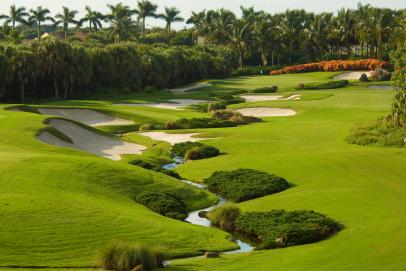
Long before he was President of the United States, or even a TV reality show host, Donald Trump built a golf course on prime real estate in West Palm Beach, which he got from Palm Beach County. In exchange for a 100-year lease, Trump agreed not to sue the county for noise disturbance to Mar-A-Lago resort. He hired Tom Fazio’s older, less-celebrated brother, Jim Fazio, to design a course that would rival Trump’s casino rival Steve Wynn’s baby, No. 24 Shadow Creek in Vegas. Jim moved 2 million cubic yards of dirt to create 58 feet of elevation change and planted 5,000 mature trees. Lakes linked by recirculating streams were built, as was a monolithic waterfall on the 17th. The result is Shadow Creek Southeast. “Steve Wynn is a friend of mine,” Trump said in a 1999 interview. “I did get certain ideas from Shadow Creek because I think he did a very good job. I made them bigger and better.”
View Course
From Golf Digest Architecture Editor emeritus Ron Whitten:
In 1972, architect Joe Lee was hired to create Banyan Golf Club, a private club on land in West Palm Beach that included 80 acres of abandoned shell-mine pits. Given the spoil mounds, the site offered elevations up to 36 feet (almost unheard of in south Florida) and several mining lakes, but it was almost barren of trees. Joe felt he needed a large number of trees to beautify the raw land, but the developer didn't have the budget for such an extravagance.
Then Joe heard that Interstate 95 would soon be pushed northward from West Palm Beach to Orlando, through forests of pine, cypress and oak. He arranged to have thousands of trees removed from the paths of advancing bulldozers and trucked to the Banyan construction site, where he would plant them along various holes.
Transplanting mature trees on a golf course is a common occurrence these days, although it is an expensive proposition. It was almost unheard of back in the early 1970s, as was the notion that one could get the trees for free. "We didn't have sophisticated tree-moving equipment they have nowadays," Joe recalled years later. "All we had was a flatbed truck and a crane. We didn't have time to prune and trim the branches back. We didn't have time to let them acclimate. We didn't even have a way to water them. He had to get in there, pull them out, haul them back, plant them and go back for more."
A lot of those trees didn't make it, but a lot of them did. Banyan opened in 1973 and within a few years, Banyan was a veritable tropical rainforest, each hole a secluded entity onto itself, framed by hardwoods salvaged from the freeway project and by more exotic varieties obtained elsewhere, like Brazilian peppers, acacia and melaleuca. Ironically, there are only three Banyan trees on the whole property. The owner just liked the name.
By the 1980s, the lush tropical canopies also began blocking much needed air and sunlight to tees and greens. Dan Jones, Banyan's superintendent at the time, instituted an aggressive program of tree-trimming and tree replacement. Out went the melaleucas and other exotics, in came fruit trees. Then came a tornado that wiped out 400 trees. That was followed by successive hurricanes, which knocked over hundreds more. But Banyan recovered and replanted again and again.
Today, Banyan is still a heavily treed golf course but now has far more palms than hardwoods, and more varieties common to south Florida. In 2012, John Sanford rebuilt the bunkers with grass faces, which was not really the style of Joe Lee, so in 2017, the bunkers were renovated again, this time by Kipp Schulties. But while Kipp's bunkers are of the flashed sand-type that Joe favored, the bunker shapes are now far more simplistic ovals than anything Joe ever built. Plus there are now acres of exposed sand under trees and around some tees, some of the sand covered in pine straw, some of it not.
I don't think it's what Joe wouldn't have advocated. Still, the basic routing has been preserved, which is good. Privately, Joe Lee had admitted to me that Banyan was his favorite design.
View Course

The Breakers is one of the most recognizable brands in hospitality. Founded by one of the leading industrialists of the 1800s, Henry Flagler, The Breakers has been a go-to destination for those seeking sun and luxury since then. There are two golf courses associated with The Breakers: The Ocean Course, which was designed by Alexander Findlay in 1897 and renovated in 2018 by Rees Jones. It’s a shorter course, tipping out at 5,778 yards, that sits right along by the beach. Jones also returned to The Breakers in 2022 to renovate a course under his name, The Rees Jones Breakers Course, which sits about 10 miles from the resort on land with subtle elevation changes and some gentle contouring in the putting complexes. This is the resort’s championship layout, measuring 7,104 yards from the tips with six different tee box options.
View Course

Located in West Palm Beach, the Club at Ibis is home to three Nicklaus family-designed golf courses. The championship-style Legends course opened in 1991 and was designed by Jack, who set out wide, sprawling fairways dotted with deep bunkers and lined with snaking water hazards. In classic Nicklaus fashion, risk-reward opportunities off the tee are plentiful, and greens often require precise angles if one wants to attack difficult pin placements. Greens are large but vary in character and size with most surrounded by tightly mown runoff areas that require creativity in one's short game. In 2017, Nicklaus returned to complete an extensive renovation focused on adding length, a new irrigation system, as well as re-grassing fairways and re-contouring greens.
View Course

Emerald Dunes was developed as a high-end public course. Now it's one of the most sought-after private courses in the Palm Beach market with initiation fees to match. The design weaves around a series of lakes, and water or marshes come into play on nearly every hole. Knowing that the lakes would be so prevalent, team Fazio played up the "aquatic theme," as he calls it, carving scalloped edge banks and nurturing native plants along the shorelines.
View Course
Designed by Jack Nicklaus and John Sanford, the team responsible for Trump Golf Links at Ferry Point in NYC and Naples Beach Hotel G.C., the new course at Banyan Cay replaces the old Presidents Country Club. The greens are undulating and often very quick. Surrounding the greens are large run-off areas to allow for either chipping or putting and large bunker complexes and greenside bunkers, including several U.K.-style pot bunkers with sod walls.
View Course
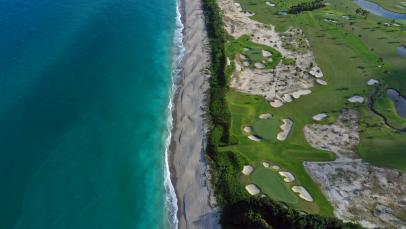
A majestic Donald Ross design with a clever routing on a rectangular site, each hole at Seminole encounters a new wind direction. The routing is perhaps the only thing that remains of Ross' vision. The greens are no longer his, replaced 60 years ago in a regrassing effort that showed little appreciation for the original rolling contours. The bunkers aren’t Ross either. Dick Wilson replaced them in 1947, his own version meant to imitate crests of waves on the adjacent Atlantic. A few years back, Bill Coore and Ben Crenshaw redesigned the bunkers again, set lower, closer to the way Ross had them, along with exposing sandy expanses in the rough. The club is about to embark on another major remodel by Gil Hanse and Jim Wagner intended to finally recreate Ross’ internal green movements based on his blueprints and elevate sections of the course to remediate drainage concerns. Seminole has long been one of America’s most exclusive clubs, which is why it was thrilling to see it on TV for a first time during the TaylorMade Driving Relief match, and then again for the 2021 Walker Cup.
View Course
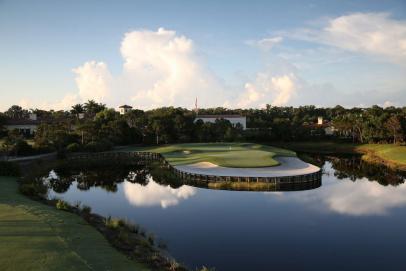
Trump bought the Ritz-Carlton resort in 2012. Its Jack Nicklaus design is one of a number of quality courses in the area—including the Bear's Club down the road and the Floridian.
View Course

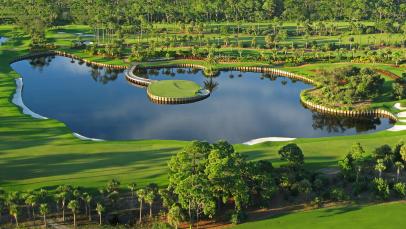
Find more courses near West Palm Beach, FL