

Going home early?
Masters 2024: How the 36-hole cut is determined at Augusta National

Ben Walton
It’s the goal of everybody in the field at the Masters, whether you’re World No. 1 Scottie Scheffler or 64-year-old past champion Fred Couples, the oldest participant this week. Qualifying to play in the year’s first men’s major is incredible, but the tournament is a lot more memorable (not to mention lucrative) if you can make the 36-hole cut and play on the weekend at Augusta National. And after the opening round finally wrapped up Friday morning, there are a handful of top-ranked players who will be sweating this out.
As the second round began at Augusta, former major champions Jason Day (75), Zach Johnson (76), Adam Scott (76), Hideki Matsuyama (76), Dustin Johnson (78), Jordan Spieth (79) and Brian Harman (81) were all in jeopardy of missing out playing all 72 holes of the tournament. Each was outside the top 50 after the first round, which is the magic number at the Masters.
Starting in 2020, tournament officials implemented new guidelines for determining the 36-hole cut. As had previously been the case, all players inside the top 50 (and any players tied) get to play the entirety of the tournament. However, an old provision that let any player within 10 strokes of the lead—the so-called “10-shot rule”—would also stick around was been eliminated.
Augusta National chairman Fred Ridley offered two reasons behind the change, the first being that it created a “reliable way” to predict the weekend field.
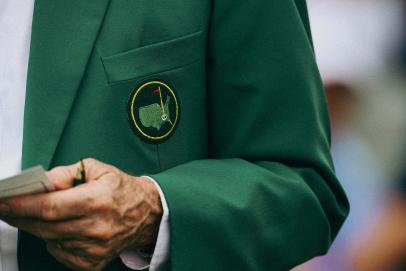


“But the other thing is we look back at the statistics, and the last few years, or the last several years, I think we’ve only had two players who have been in contention who made the cut only because of the 10-shot rule,” Ridley said. “While certainly it can happen, it just doesn’t. It’s not relevant that often, and we thought this was a way to sort of tighten things up and have a more predictable field size for the weekend.”
Indeed, using scores from the first round, the cutline would be a two over par, with 16 players tied at T-47 on that number and 62 of the 89 players advancing.
What will this year’s Masters 36-hole shake out to be? If all goes well, the second round should be completed on Friday night as all tee times remained the same despite the first round carrying over into Friday morning. As of 3:15 p.m. Friday, Datagolf.com was predicting a 70.9 percent chance the cutline comes at four-over 148 and a 28.3 percent chance it jumps to five-over 149.
Arguably the most intriguing person to watch for regarding the cutline is Tiger Woods. Coming into this year’s Masters, Woods has made the cut in 24 of his 25 Augusta starts, including his last 23 straight. That’s tied for the most consecutive cuts made, a record Woods shares with Gary Player and Fred Couples. Woods shot a one-over 73 that left him tied for 35th place.

Tiger Woods during Friday morning's completion of the first round at the 2024 Masters.
Ben Walton
Augusta National’s decision to do away with the 10-cut rule brought it in line with the other three men’s major championships in terms of how they determine their cuts. At the U.S. Open, the low 60 players and ties play all four rounds. At the Open Championship and the PGA Championship, it’s the low 70 and ties.
With the soft conditions at Augusta in November 2020, the cutline for the tournament was at a record-low even-par 144. Last April, it returned to its more traditional over-par range. Here’s what the cut line has been for the last 10 Masters:
2023: 147 (+3)
2022: 148 (+4)
2021: 147 (+3)
2020: 144 (E)
2019: 147 (+3)
2018: 149 (+8)
2017: 150 (+6)
2016: 150 (+6)
2015: 146 (+2)
2014: 148 (+4)
2013: 148 (+4)
The average cut at the Masters is 148.4. The highest cut was 154 (+10) in 1982.
For history buffs, here are some stats related to the cut at the Masters:
MOST CUTS MADE
37, Jack Nicklaus
31, Fred Couples
30, Gary Player
27, Raymond Floyd
27, Bernhard Langer
27, Phil Mickelson
25, Ben Crenshaw
24, Tom Watson
24, Tiger Woods
23, Billy Casper
23, Arnold Palmer
LONGEST STREAK OF CONSECUTIVE CUTS MADE
23, Fred Couples (1983-2007)
23, Gary Player (1959-1982)
23, Tiger Woods (1997-2023)
21, Tom Watson (1975-1995)
19, Bernhard Langer (1984-2002)
19, Gene Littler (1961-1980)
18, Billy Casper (1960-1977)
16, Phil Mickelson (1998-2013)
15, Bruce Devlin (1964-1981)
15, Jack Nicklaus (1968-1982)
13, Ben Crenshaw (1980-1992)
13, Nick Faldo (1979-1996)
13, Raymond Floyd (1973-1985)
13, Corey Pavin (1985-1998)
13, Justin Rose (2003-2018)
• • •
MORE GOLF DIGEST MASTERS COVERAGE