Best golf courses near Port Saint Lucie, FL
Below, you’ll find a list of courses near Port Saint Lucie, FL. There are 54 courses within a 15-mile radius of Port Saint Lucie, 22 of which are public courses and 32 are private courses. There are 46 18-hole courses and 8 nine-hole layouts.
The above has been curated through Golf Digest’s Places to Play course database, where we have collected star ratings and reviews from our 1,900 course-ranking panelists. Join our community by signing up for Golf Digest+ and rate the courses you’ve visited recently.
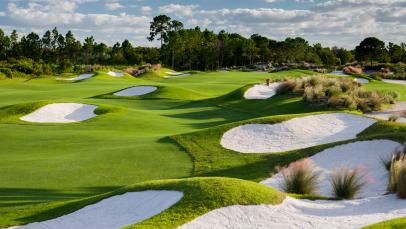
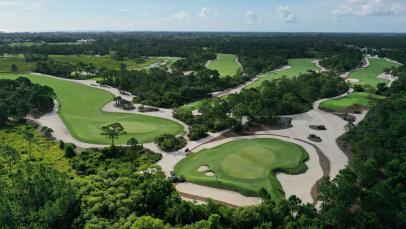
The Dye Course at PGA Golf Club in Port St. Lucie is a links-style course routed through wetlands. Pine straw, coquina waste bunkers and grass bunkers capture the Florida setting, while the layouts of the holes draw strongly on British Isles roots.
View Course

If there’s such a thing as an undiscovered Tom Fazio design, it’s McArthur Golf Club's Front Yard, a players-only layout he did in conjunction with PGA Tour star Nick Price. It’s little-known because of its neighbors, Jupiter Hills, a few miles south, Hobe Sound Golf Club, one of Joe Lee’s finest, just a few miles closer and Greg Norman’s Medalist Golf Club right next door. (Michael Jordan's The Grove XXIII, the Apogee Club, the new Discovery Land Company's Atlantic Fields and Tom Doak's new Sandglass are all a short drive to the west). McArthur sits astride the same sand ridge upon which Jupiter Hills and Medalist were built, and while Fazio had to deal with wetlands and easements in his routing, he framed each hole with acres of exposed white sand in the form of dunes, slopes and hollows to provide the Front Yard with a singularly stunning look that’s unlike any of its rivals. With those wide expanses of sand, McArthur started a trend that continues today. The club's new Back Yard course, built by Bill Coore and Ben Crenshaw in interior wetlands just inland from the original course, opened in 2023.
View Course
Medalist is a long, demanding course that can stretch out to roughly 7,600 yards, a necessary requirement when the membership includes Tiger Woods, Dustin Johnson, Rory McIlroy, Brooks Koepka and many more of the world’s top professional players. They like Medalist for the relaxed atmosphere and local convenience, but also because it’s a demanding driving course—the holes circle through an undeveloped sanctuary of wetlands and low scrub vegetation one parcel south of McArthur (No. 157) and are buffeted by the strong Atlantic crosswinds. Pete Dye designed Medalist with co-founder Greg Norman (this was one of Norman’s first U.S. designs), and the course features Dye’s S-shaped holes curling around sand buffers, slinky ground contours and small, low-profile greens that bleed into short-grass surrounds. The course had undergone numerous modifications and formalizations in the late 1990s and early 2000s, some by Norman, but Bobby Weed reclaimed much of the original Dye character during a 2015 renovation.
View Course

The bunkering at Floridian National distinguishes it from many of the other uber-private Southwest Florida courses. Between the bright white sand and clamshell shapes, with softly rising tall lips, the bunkers share many similarities to those at Augusta National. They play an integral role in the strategy at this 7,100-yard Gary Player design, as they often pinch in where longer players would be landing off the tee. The long par-4 18th is a strong finisher and roughly resembles the famous closers at TPC Sawgrass and Pebble Beach, with the hole boomeranging to the left as water runs up the entire length of the hole. Floridian is a popular practice spot for many pros, and Claude Harmon III, Butch’s son, is the Director of Instruction.
View Course

Sailfish Point is a unique golf and residential club that occupies some of the most valuable land on the Florida Atlantic Coast. It’s set on an isthmus called Hutchinson Island just north of Jupiter Island between the ocean, the Intracoastal Waterway and the St. Lucie Inlet, connected to land by a narrow causeway. The Jack Nicklaus-designed course, one of his firm’s earliest that opened in 1981, occupies the center of the island, though homes flank most of the parallel-paired holes. The design, fully renovated in 2022, does touch the water with the 14th green set on the shore of the inlet and the 18th “Window to the Sea” green perched above the Atlantic beach, but the best hole might be the 184-yard par-3 12th angled tightly against a marshy canal, a ringer for the brutal 17th hole at The Ocean Course at Kiawah Island though this one came eight years before the other.
View Course

The golf world couldn’t wait to find out more when word got out in 2020 that NBA legend Michael Jordan had opened his own golf course in Florida, less than ten miles from his former club, The Medalist. Called The Grove XXIII (for the number Jordan wore through most of his career), the course seemed exotic and intriguing: a private retreat for Jordan and his buddies (including athletes from other realms), built on a bare bones parcel of agricultural land by Bobby Weed with one of the most technologically advanced practice facilities in the U.S. The design was equally inventive with holes that cross over so they can be played in shorter loops and routing configurations, full of half-par 4s and 5s to stimulate action in the high stake matches constantly being waged. Five years later The Grove XXIII design remains fresh, but the concept of a new course in these parts less so. The neighborhood has exploded with McArthur’s Back Yard by Bill Coore and Ben Crenshaw just to the east, Apogee Club’s three 18-hole courses down the road, Tom Doak’s Sandglass just beyond that, the new 36-hole development called The Ranch across Highway 76 from Apogee now getting underway and Discovery Land Company’s Atlantic Fields literally outside the doorstep. Hobe Sound is has become ground zero for premium golf development in Florida, but as has been so often the case in his life, Jordan set the standard and did it in a way no one else can replicate.
View Course

Situated on a tight, triangularly shaped property about a mile from the Atlantic Ocean in Hobe Sound, Fla., Loblolly is a challenging Pete and P.B. Dye design. Angles are key at Loblolly, as many of the narrow and tilted greens are best attacked from one side of the hole. The Dyes were ingenious when they built the course in the late 1980s, using excavated sand from the retention ponds to create rambling fairway movement and 40-foot-high dune ridges on which to place greens and separate holes. The same concept was later used by architects at Calusa Pines, McArthur and other South Florida courses, but Dye did it at Loblolly first. Highlights include the double-dogleg eighth with a huge bi-level green banked against water, the drivable par-4 13th, where the green is nestled in a sandy cove behind sentry pines, and the par-4 14th, a standout version of Dye’s Alps hole with the green obscured by a large ridge. The par-3 16th is one of the more dramatic holes in the region, as any shot coming up short and right will filter down into a bunker 20 feet below the putting surface. Golf course builder Jim Urbina, who worked for Dye in the 1980s, completed a full refurbishing of the course in 2023, painstakingly restoring the craft and details of the original design that had faded through the years.
View Course

The course opened as Cobblestone Country Club in 1989 and underwent an extensive renovation by Darren Clarke and Eoghan O’Connell a decade ago. New ownership arrived in 2022 and retouched everything at the club. The club recently flipped its nines, which means a friendly par 5 to ease a golfer into the round and a demanding double-dogleg par 5 (586 yards from the tips!) around water as the new 18th. A solid drive, precise layup (cut off what you dare) and smartly played third can lead to one final birdie. The par 3s are memorable, especially the island green 15th hole. The Cape Club of Palm City might sit in relatively flat Florida, but the golf course offers surprising elevation changes.
View Course
Find more courses near Port Saint Lucie, FL