
I played Yale all season—here's the truth about its conditions
Editor's Note: Benjamin Herms is a Golf Digest course-ranking panelist, whose evaluations help determine our biennial rankings of America's 100 Greatest Courses. He lives in New Haven, Conn., and has play Yale Golf Course 20 to 30 times since 2015.
Nov. 1 marked the end of Yale Golf Course’s centennial season. The year was meant to celebrate a two-season renovation. Instead, for many people the lasting image was deteriorating turf, after Gabby Herzig’s story in The Athletic documented Yale’s struggles.
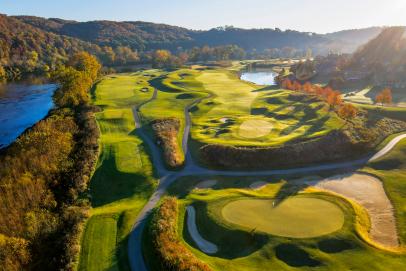
On my first visit in May, I was floored by how much contour Gil Hanse and Jim Wagner had restored to the course’s massive greens. Hanse’s master plan for the course is displayed beside a copy of Raynor’s original plan in the foyer of the golf house, and it’s clear that the two drawings share nearly identical intent. Apart from a few new tee boxes that stretch holes to combat modern distance, no significant departures from the strategic elements Raynor built in 1926 were apparent during that first visit. Subsequent trips down Conrad Drive allowed me to inspect the changes and the course in greater detail.

Benjamin Herms
Despite the increased airflow afforded by the tree removal, it was clear that the work done would further stress the maintenance operation for a facility with an unfortunate track record. Yale Golf Course has been referred to in golf architecture circles as “one of the best courses in the country, regardless of its conditioning.” I hoped that the modernized irrigation and drainage systems would let the new superintendent and his team manage the property more effectively than past teams had.

Benjamin Herms
In May and June, it was clear the maintenance team was finding its footing, capably managing the sizable playing corridors with modest heights of cut and putting surfaces at reasonable speeds. It’s hard to grasp Yale’s scale without playing a round there. The eighth and ninth greens are each around 80 paces long, and the 18 greens together likely cover twice the square footage of those at most private clubs in the area.

Benjamin Herms
During a visit in July, I noticed scalping on severe green contours, such as those on the ninth (above, cropped from a photo taken July 12; below). The summer had been dry and mild until then, so firm conditions meant these areas had little effect on playability or strategy.

Benjamin Herms

LC Lambrecht


BEN WALTON

BEN WALTON

BEN WALTON
The favorable conditions that ushered in summer 2026 turned sour in late July. Rainfall from July through September was nearly double the monthly average, per Precip.ai. In August and September, I began hearing about disappointing turf conditioning, later condemned by The Athletic’s article. Fearing that conditions had deteriorated since earlier in the year, I visited the course and found that most of the damage was on the margins of the course, and that playability was typically unaffected. That said, at up to $350 for a tee time, I understand why some players were miffed. Discussions with course staff and others familiar with the operation suggested that changes were coming. During the drier weeks that followed, I returned for one last round, Oct. 22, nine days before the course closed for the season.
When I arrived, there was a sod truck in the parking lot. General Manager Zach Happy told me that truck was the second one to arrive that day and that work was underway to fix the problems. I was told the course was walking-only for the rest of the year, and that there was plenty of room in front of me. I set out to the new championship first tee, encouraged that the course would yet again live up to the lofty standard I experienced earlier in the year. Walking up the first fairway, I noticed that the margins I’d seen from the pro-shop window in late September had visually improved, likely facilitated by the lack of cart traffic. The next realization I had was that several dry days had allowed the fairways and greens to substantially firm up, evidenced by the bounce and roll of my drive on the second hole, which has always been one of my favorites (below).

Benjamin Herms
More from Golf Digest
If you want shot-by-shot commentary of my round, you’ll have to reach out directly. In short, Yale’s championship layout will challenge even the best players, and while I don’t fit into that category (my handicap index is a 2.8), a high IQ golfer wouldn’t have any complaints about the conditioning that I saw that day. The greens were faster than they’d been in July, and the rough had thickened due to the wet summer. Thin areas on the greens were healing, and previously patchy areas in fairways were actively being re-sodded and watered (10th hole, below). Flags marking new sprinkler heads were distributed among fairways and in the rough, and newly hired superintendent Pat Sisk was patrolling in a cart, taking notes and directing his crew. I spoke with him during my round and was encouraged by his admiration of the course, its history and its architectural merits. He asked if I’d captured any good photos, and we discussed the walkable nature of the course before I went off to search for my tee shot on the 10th hole. The inward nine had been mostly cleared of fallen leaves, and the setting sun illuminated the bright green bentgrass as I continued playing through the iconic templates.

Benjamin Herms
Expanded teeing areas on the 11th hole will spread wear to the turf on a hole where many players hit less than driver. A widened, firm fairway makes this par 4 nearly drivable, provided you avoid the bobcat footprints in the left bunker (below) and the exposed rock above it.

Benjamin Herms
More from Golf Digest

If the maintenance staff stays committed to providing firm turf, the course will keep improving. I can’t overstate how much the improved drainage and agronomic practices have enabled an environment where the ball bounces and rolls. The comprehensive restoration has brought back much of the course’s century-old strategic intent. The current layout is bold, challenging and beautiful. It tests a player’s mind and skill, while retaining quirky elements that separate it from sanitized modern courses.

Benjamin Herms
The collective portfolio of courses designed by Raynor, C.B. Macdonald and Charles Banks is largely closed off to the public behind gates. Yale gives every player the chance to see some of that lineage’s most astounding work, and students and university affiliates get a discount. The golf staff and maintenance team are committed to delivering an elevated experience at a gem from golf architecture’s golden age. In this panelist’s opinion, each of the creative decisions made in the restoration was a success. Conditions were excellent at the end of the centennial season, and the aesthetic details are set to improve when Gil Hanse returns in the offseason to make tweaks. The gnome stands proud.
Benjamin Herms is a Golf Digest course-ranking panelist and golf photographer based in New Haven, Conn. You can follow his work here.
• • •
Explore Golf Digest's recently relaunched Course Reviews community, where you can add star ratings and reviews for all the courses you play. We've collected tens of thousands of reviews from our course-ranking panelists to deliver a premium experience, which includes experts' opinions, bonus course photography and videos, plus much more. Check it out here!
