
Surprised how the Presidents Cup has evolved? You can’t be more than the captains from the inaugural 1994 match
Imagine you’re the commissioner of the PGA Tour in 1993 surveying the golf landscape. You are watching the Ryder Cup—a money loser for decades—become the most dynamic event in golf and growing in popularity in the general sports marketplace. Which means it is a financial windfall for the PGA of America and the European PGA. Yet many of the best players in golf are foreign-born non-Europeans—Greg Norman, Nick Price and Vijay Singh among them. These players would welcome a chance to participate in a similar team match-play event. The tour is looking for a way to get in on a sure cash-generating machine, especially after passing on the Ryder Cup in its split from the PGA of America in 1968 and opting to retain the World Series of Golf.
You would do what Tim Finchem, the commissioner at the time, did. You would launch your own event. Thus was the Presidents Cup introduced in 1994, with an American team pitted against an International contingent of players from the world over except Europe. It was destined to be a bonanza, both financially and competitively. Jack Nicklaus, whose proposal in 1977 to add players from continental Europe to an undermanned Great Britain and Ireland team, spurred the growth of the Ryder Cup, predicted that the Presidents Cup would surpass its more established cousin, given the pool of talent and the audience was simply so much larger.
Players from Australia, Japan, South Africa, Canada, Zimbabwe, South Korea and China would mount a serious challenge to a U.S. team. And after two defeats in the U.S., the second by only one point, the International team dominated the Americans, captained by Nicklaus, with a nine-point triumph in Melbourne in 1998.
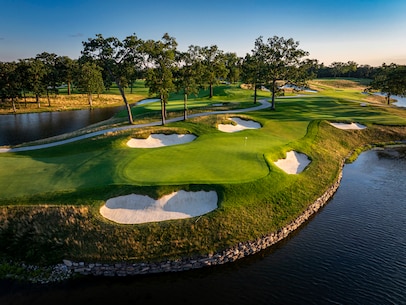
When the 16th Presidents Cup begins this week at Medinah Country Club, the International team will still be seeking its second win in the series. Other than a tie in South Africa in 2003, every outcome since 1998 has gone to the Americans.
Obviously, things haven’t quite gone according to plan. Make no mistake, the Presidents Cup has been a tremendous financial success for the PGA Tour. But from a competitive standpoint, it has fallen short.
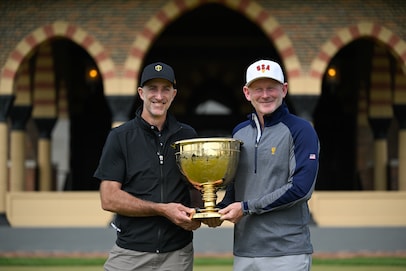
No one is more surprised by this than the captains of that inaugural event at Robert Trent Jones Golf Club in Manassas, Va. Australia’s David Graham led the International team, while Hale Irwin served as playing captain for the U.S., while deputizing Paul Azinger to serve as his assistant.

The U.S. won easily in the first outing, 20-12, with Norman sitting out of the competition and Ernie Els only recently emerging as a force. But the International team still fielded a lineup that included world No. 1 Price, fellow Zimbabwean Mark McNulty (15th in the world), Singh, David Frost and Steve Elkington. When Norman joined the contingent in 1996, the host Yanks pulled out a 16½-15½ victory thanks to Fred Couples beating Singh in the anchor singles match.
“Absolutely I’m surprised by it when you look at the quality of players who have represented the International side,” said Irwin, who went 2-1, splitting foursomes matches before beating Robert Allenby in singles, 1 up. “I can only think that as time has gone on, the teams come in with a sense of trepidation because the U.S. has built up all the momentum over the years. Early on it was new to those players, but the game is so different now. There are great players from everywhere who play the tour and know how to compete.”

David Graham and Hale Irwin on the course at the inaugural 1994 Presidents Cup.
PGA TOUR Photo Services
Nevertheless, the Internationals have been close a time or two, but in the 15 previous meetings, the U.S. has won by three points or more 10 times and is riding a 10-match winning streak.
“You look at the World Rankings and the Americans are clearly the stronger team most years,” Graham said. “So in a way I’m not that surprised. Early on, we had players who just weren’t equipped to take on the Americans in match play, but that’s really not the case anymore, so I would have thought we’d have more success at this stage.
“In the Ryder Cup, the Americans usually looked stronger on paper, but Europe finds ways to win,” Graham continued. “They [Europeans] played with a chip on their shoulders and they’ve won quite often. The odds would say that should happen at some point in the Presidents Cup a time or two, but it hasn’t. So in that regard I am very surprised.”

With the Americans winning the inaugural match, the event has become a lop-sided affair with the U.S. leading 13-1-1 overall.
Gary Newkirk
Irwin and Graham agree that while the International team has cultural challenges to overcome that European players do not, the talent on the International side has been sufficient.
“They don’t have to rally around one flagpole to play well,” said Irwin, a three-time U.S. Open champion who somehow was never tapped for a Ryder Cup captaincy. “They play in America. They know one another. They have outstanding rosters. It comes down to each player doing his best. It’s always an intangible, and you don’t ever know what that is”
“What the Presidents Cup needs,” Graham said, “is that one wake-up moment. The International team needs to do what the Europeans did to the United States [winning in 1987 at Muirfield Village]. All of a sudden, it became a battle, and it became a more desirable thing to be in the Ryder Cup. It lit a fire. I don’t know if that can happen next week or not, but my hope is it happens soon.”
Europe for a number of years fielded a powerful lineup led by Sir Nick Faldo, Ian Woosnam, Sandy Lyle, Jose Maria Olazabal, Bernhard Langer and their emotional firebrand, Seve Ballesteros, while captain Tony Jacklin changed the culture with strong leadership.
Irwin said that he watched Graham pour his heart into that first Presidents Cup, and Gary Player, Nick Price and Ernie Els subsequently have brought passion to the International captaincy. Els further attempted to strengthen the concept of International unity by creating its own team symbol, the Shield.
Nevertheless, something has been missing more than just missing putts. Or maybe it is that simple.
“Honest to God, it’s shocking to me they haven’t won more,” said Azinger, who led a U.S. victory over Europe in the 2008 Ryder Cup at Valhalla Golf Club in Louisville, Ky. “If you’d predicted in 1994 that the International side would have only one win at this point, I would have bet big you would be wrong. It’s pretty amazing. I think one aspect of it is the support. Who rallies around the International team the way American and European fans pull for their teams? That’s what makes the Ryder Cup special is how the fans get so engaged.”
Graham agrees.
“We need more support rallying around the International players,” said the two-time major winner. “There's no chanting about ‘go international, go international’. And then they hear everybody screaming for USA, USA. And it's hard for the International team to gain any emotional ground. And I think the only way that that will happen is if all of a sudden, they win and people go, ‘Oh, what the hell just happened?’
“I always feel like the players we have are capable. But it’s always somewhat of an uphill battle. I didn’t see that happening the way it has played out.”
Well, he has plenty of company.


